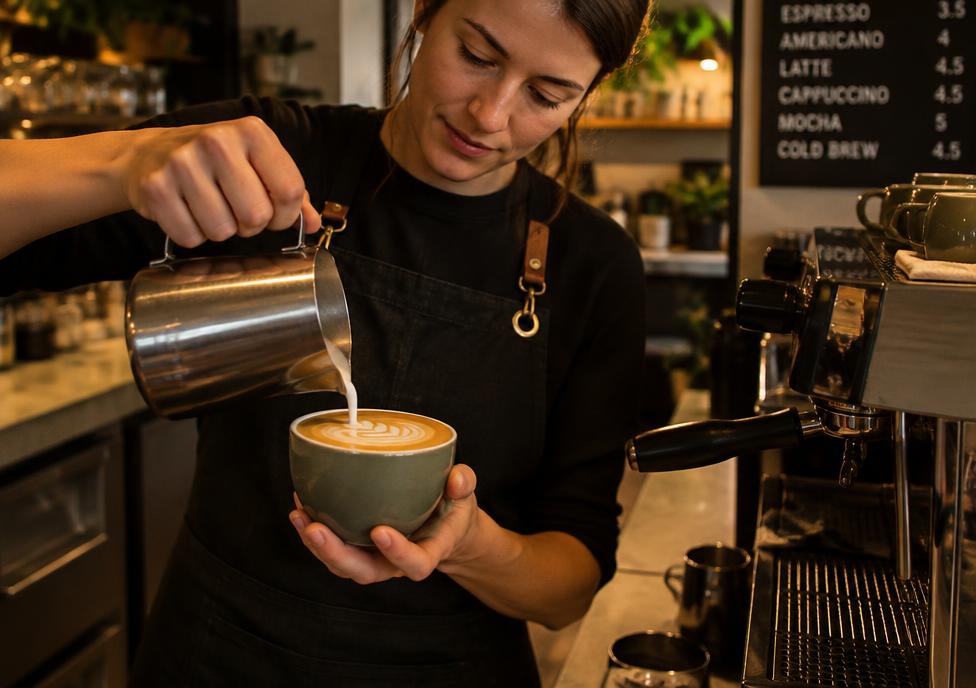
Almost every café drink starts with espresso, a small, strong coffee made by forcing hot water through finely ground coffee. Add hot water for an americano, or steamed milk and foam for a latte or cappuccino.
Why it matters
Guests ask how drinks differ and notice when a cappuccino looks like a latte. Knowing the basics helps you get orders right.
Key ideas
Roast
Lighter roasts taste brighter and fruitier; darker roasts taste more bitter and chocolatey.
Single and double shots
A double uses twice the coffee of a single. Many cafés use it as the base for most drinks.
Milk and foam
A cappuccino has a thick foam layer, a latte is milkier with a thin one, and a flat white is smaller and stronger.
Step by step
- 1
Note each drink's cup size on the menu.
- 2
Learn the house recipe for shots, milk and foam.
- 3
Taste a plain espresso to learn the house flavour.
- 4
Practise describing each drink in one sentence.
- 5
Ask a senior barista to check your drinks.
Do
- Learn your café's own recipes, as names and sizes vary.
- Offer decaf or plant-based milk when your café stocks them.
- Ask one quick question when an order is unclear.
Common mistakes
- Don't assume a drink name means the same everywhere.
- Don't guess ingredients when a guest asks about allergies.
- Don't correct how a guest pronounces a drink name.
The situation
A guest asks how a latte differs from a flat white. They want something strong but not too milky.
What a professional does
You explain that a flat white is smaller, with less milk, so the coffee tastes stronger. You recommend it and confirm their milk choice.
Useful phrases
“A flat white is smaller and stronger; a latte is bigger and milkier.”
“Would you like regular milk or one of our alternatives?”
Pro tip
Keep a recipe card by the machine until you know every drink.
Quick check
How does a cappuccino differ from a latte?
Think about it, then show the answer
A cappuccino has a thicker layer of foam; a latte is milkier with a thin layer.