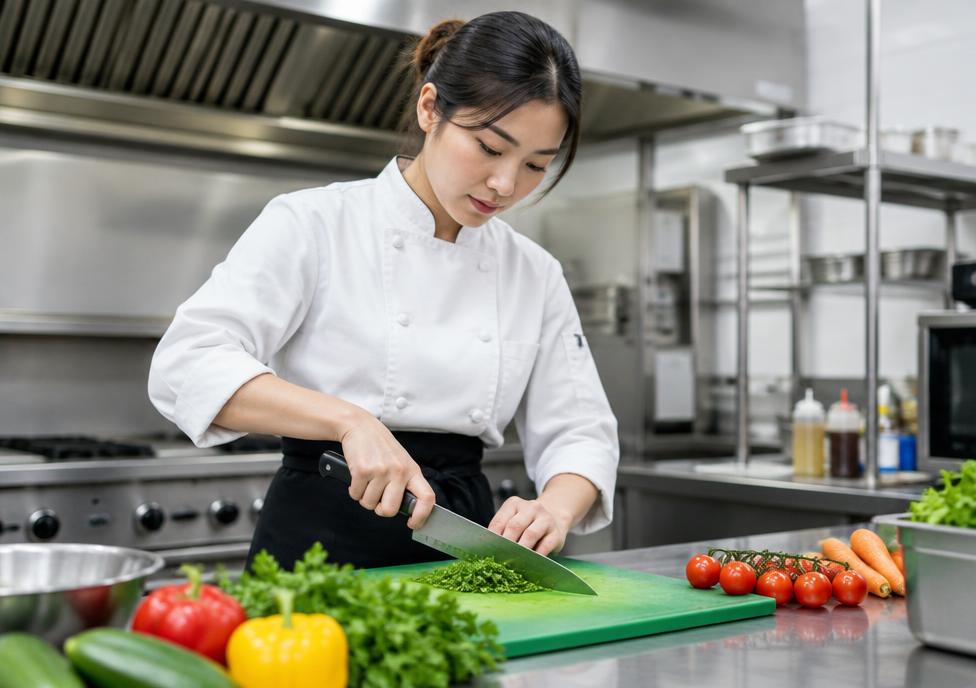
Much of your day is preparation: washing, peeling and cutting ingredients for the chefs. Basic cuts such as slices, dice and julienne, all cut to a consistent size, form the mise en place for service.
Why it matters
Evenly cut food cooks at the same speed and looks professional. Fast, accurate prep lets chefs focus on cooking during service.
Key ideas
Consistent size
Pieces of the same size cook evenly, so none are raw or overcooked. Match the size the chef shows you.
Basic cuts
Common cuts are slices, dice (small cubes), julienne (thin matchsticks) and fine chopping. Names and sizes vary, so ask for an example.
Blanching and refreshing
This means cooking vegetables briefly in boiling water, then plunging them into iced water to stop the cooking and keep their colour.
Step by step
- 1
Read the prep list and ask about any cut you don't know.
- 2
Gather your ingredients, containers, board and knife.
- 3
Wash produce before peeling or cutting it.
- 4
Give round items a flat base before cutting.
- 5
Cut to size and store in clean, labelled containers.
Do
- Work in batches: peel everything first, then cut.
- Show the chef your first few pieces.
- Keep peelings apart from finished prep.
Common mistakes
- Don't use one board for raw meat and ready-to-eat food without sanitising it between.
- Don't cut a vegetable that rolls on the board.
- Don't chase speed before accuracy.
The situation
The chef asks you to dice a box of carrots for soup and a garnish, but you're not sure what size is needed.
What a professional does
You ask, "What size, chef, and the same for both?" It's rough dice for soup, fine for garnish. You cut a few of each, show the chef, then finish.
Useful phrases
“Chef, is this the size you want?”
“How much of each do you need?”
Pro tip
Keep a bowl beside your board for peelings so your area stays clear.
Quick check
Why cut vegetables to the same size?
Think about it, then show the answer
So they cook evenly and look consistent on the plate.