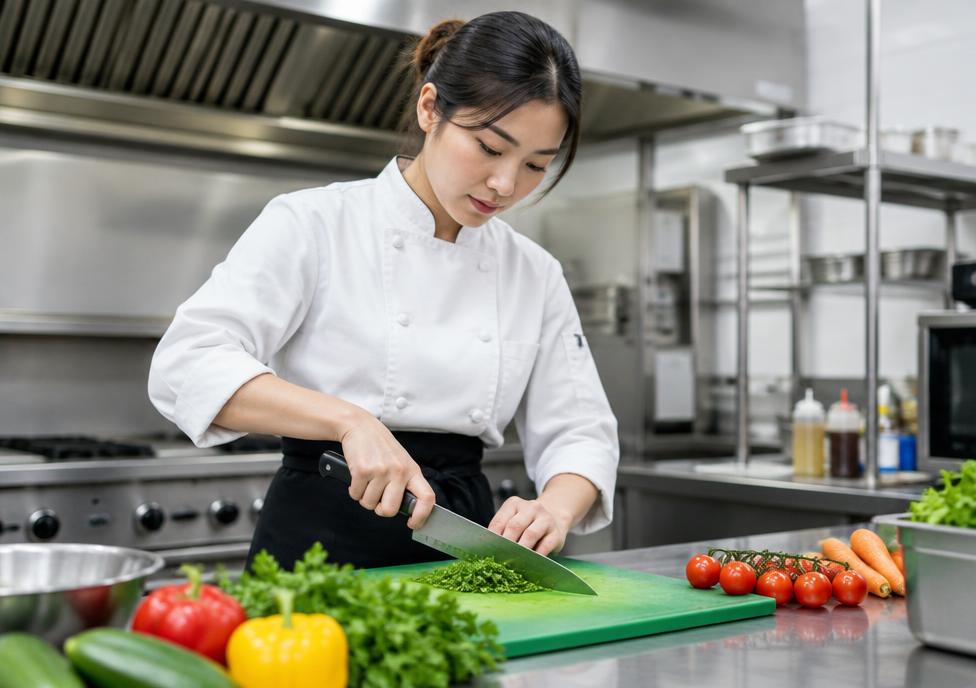
The knife is your most-used tool and one of the most dangerous. Use a stable board and the claw grip, and move knives with care. A sharp knife is safer than a blunt one, because it needs less force and slips less.
Why it matters
Knife cuts are among the most common kitchen injuries, and one bad cut can end your shift and contaminate food.
Key ideas
The claw grip
Curl the fingertips of your guiding hand under and rest your knuckles against the blade, so it cannot reach your fingertips.
A stable board
Put a damp cloth or non-slip mat under the board. Boards are often colour-coded by food type, but colours vary by venue.
Carrying knives
Hold the knife point down, blade by your side and edge facing back, and warn people as you pass.
Step by step
- 1
Choose the right knife and check it is sharp and clean.
- 2
Put a damp cloth under your board.
- 3
Grip the handle firmly and claw your other hand.
- 4
Cut with smooth strokes, eyes on the blade.
- 5
Wash, dry and store the knife when you finish.
Do
- Lay knives flat on the board, away from the edge.
- Pass a knife by putting it down for the other person.
- Report blunt knives or loose handles.
Common mistakes
- Don't catch a falling knife; step back and let it drop.
- Don't leave knives in the sink or hidden under cloths.
- Don't use a knife to open tins or prise off lids.
The situation
A colleague bumps your arm, and your knife slides off the board towards the floor.
What a professional does
You step back and let it fall, then pick it up by the handle, wash it and steady your board.
Useful phrases
“Knife, behind you.”
“Chef, this knife is blunt. Can I sharpen it?”
Pro tip
Scrape food off the board with the back of the blade, not the sharp edge.
Quick check
Why is a sharp knife safer than a blunt one?
Think about it, then show the answer
It needs less pressure, so it is less likely to slip into your hand.