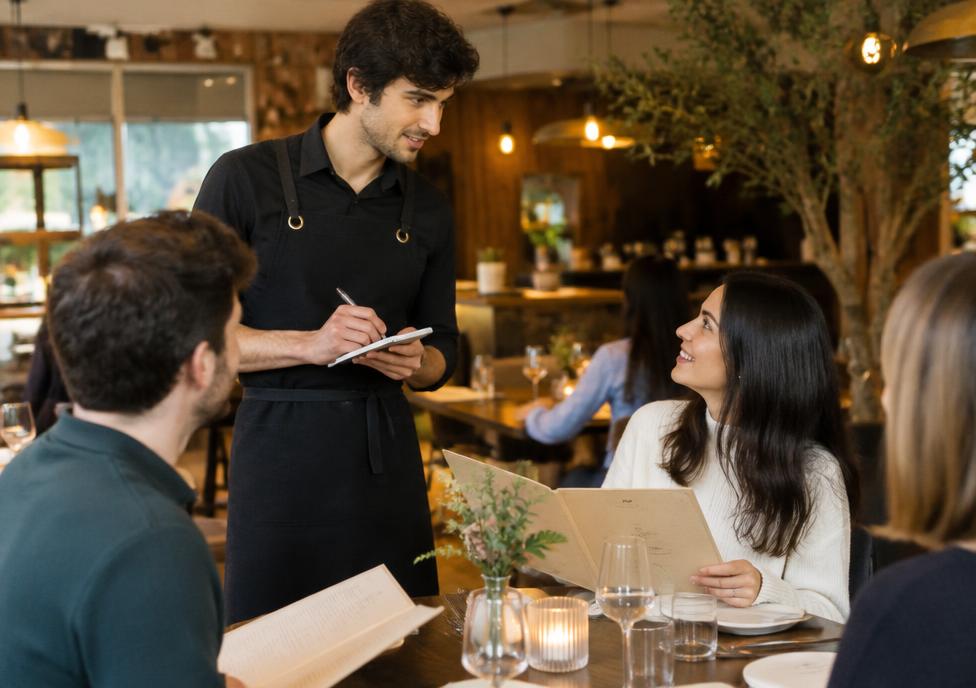
Good timing means serving each course when guests are ready, not too fast and not too slow. You read the table and tell the kitchen when to cook the next course, which is called calling away the course or asking the kitchen to fire it.
Why it matters
Mains that arrive during starters feel rushed, and long gaps feel forgotten. Good timing also spreads the kitchen's workload.
Key ideas
Hold and fire
'Hold' means the kitchen waits; 'fire' means start cooking that course now.
Reading the table
Watch how fast guests eat and how much they chat. Knife and fork placed together usually means finished.
Clear before you serve
Clear the last course and set fresh cutlery before the next dish arrives.
Step by step
- 1
Send the order with starters to go now and mains on hold.
- 2
Watch the table while they eat their starters.
- 3
Fire the mains when most guests are nearly finished.
- 4
Clear the starters and set the main course cutlery.
- 5
Serve the mains together, then check back.
Do
- Learn which dishes take longest to cook.
- Tell the kitchen if a table wants to slow down.
- Serve everyone at a table at the same time.
Common mistakes
- Don't fire a course and then disappear.
- Don't clear plates while others are still eating, unless your venue's style allows it.
- Don't delay a table without telling the kitchen.
The situation
Table 9 are eating their starters slowly, and one of their mains takes about 15 minutes to cook.
What a professional does
You keep the mains on hold and pass the table every few minutes. When most guests are about two-thirds through, you fire the mains. By the time you have cleared and reset, the food is ready.
Useful phrases
“Chef, can I fire mains for table 9, please?”
“Would you like a little more time before your mains?”
Pro tip
Watch the table rather than the clock, because the guests set the pace.
Quick check
What does it mean to 'fire' a course?
Think about it, then show the answer
Telling the kitchen to start cooking that course now.